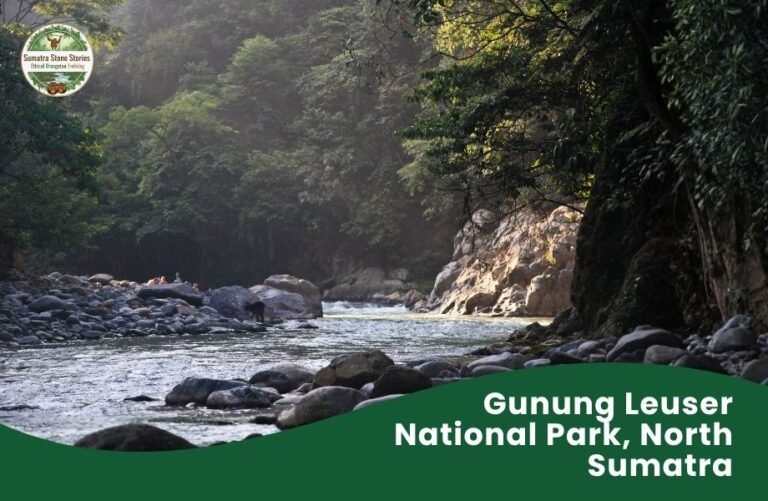
Gunung Leuser National Park sits across the border of North Sumatra and Aceh, covering nearly 7,927 square kilometers of rainforest, rivers, and volcanic peaks. It is one of the largest protected wilderness areas in Southeast Asia, and one of the last places on Earth where wild Sumatran orangutans still swing through the canopy on their own terms.
The park takes its name from Mount Leuser, a peak that rises to 3,404 meters and anchors the Barisan mountain range running through the reserve. Established in 1980, Gunung Leuser is part of the Tropical Rainforest Heritage of Sumatra, a UNESCO World Heritage Site shared with Kerinci Seblat and Bukit Barisan Selatan. UNESCO currently lists the site as “in danger,” largely because of illegal logging, encroachment, and habitat loss from palm oil expansion.
Why the Park Matters
Gunung Leuser is home to roughly 700 to 750 documented animal species. That includes more than 200 mammals, nearly 400 bird species, and close to 200 reptiles and amphibians. It is one of only two places in the world where orangutans still exist in the wild, alongside Borneo, and the only place where you can find the Sumatran orangutan specifically, a species found nowhere else on the planet.
Beyond orangutans, the park protects some of the rarest large mammals in Asia. Sumatran tigers, Sumatran rhinoceroses and Sumatran elephants all survive here, though sightings are rare given how elusive these animals are. Visitors are far more likely to spot Thomas leaf monkeys, long-tailed macaques, siamang, hornbills and the occasional monitor lizard along the trails.
Bukit Lawang: The Gateway to the Park
Most travelers experience Gunung Leuser through Bukit Lawang, a small village on the Bahorok River that sits right at the park’s edge. The name translates loosely to “door to the hills,” which fits its role well. In 1973, a Swiss conservation group opened an orangutan rehabilitation center here to reintroduce rescued and orphaned orangutans back into the wild. That center closed to daily feedings years ago, but its legacy shaped Bukit Lawang into the main starting point for jungle trekking in the region.
From Bukit Lawang, trekking routes range from short half-day walks to 6-day Sumatra treks deep into the forest. Guides who know the terrain and the animals’ patterns lead these hikes, since the jungle here is dense, humid, and easy to get lost in without local knowledge. This is also the reason ethical, well-trained guiding matters so much in this park. A knowledgeable guide keeps both visitors and wildlife safe, and helps maintain the distance and behavior standards that protect semi-wild orangutans from stress or disease transmission.
Sumatra Stone Stories runs jungle trekking tours out of Bukit Lawang into Gunung Leuser National Park, with trip lengths built around how much of the rainforest a traveler wants to see, from a single-day trek to longer multi-day routes toward Berastagi and Lake Toba.
Ketambe: The Research Side of the Park
Further north in Aceh province lies Ketambe, home to a long-running primate research station established in 1971 by Dutch researcher Herman Rijksen. Ketambe is less visited than Bukit Lawang and offers a quieter, more remote trekking experience, along with a chance to see orangutan populations that have been studied continuously for decades. It tends to appeal to travelers who already have jungle trekking experience and want a deeper, less touristed encounter with the forest.
Best Time to Visit
Sumatra’s dry season, generally running from March through September, offers the most reliable trekking conditions. Trails become slippery and river crossings riskier during the wet months of November through February, though wildlife spotting can still happen year-round since orangutans and other species don’t follow a tourist calendar.
Responsible Trekking Matters
Gunung Leuser’s orangutans are not zoo animals, and treating them that way puts both people and the species at risk. Reputable trekking operators (Like Sumatra Stone Stories) maintain a minimum distance from wild orangutans, avoid feeding them, and keep group sizes small enough that the forest doesn’t feel overrun. Since orangutans share close to 97 percent of human DNA, they’re also vulnerable to human illnesses, which is part of why ethical operators are strict about distance and hygiene during treks.
Choosing a guide who follows these standards isn’t just a matter of etiquette. It directly affects whether this park still has wild orangutans left to see in another twenty years.
A Park Worth Protecting
Gunung Leuser National Park represents one of the last intact rainforest ecosystems in Sumatra, and arguably one of the last chances to see an ancient forest system still functioning close to how it always has. Every trek through Bukit Lawang or Ketambe supports the local economy that has grown around conservation rather than logging or plantation clearing, giving the forest a reason to stay standing.
For anyone drawn to wildlife, remote landscapes, or simply a rainforest that still feels wild, Gunung Leuser offers something increasingly rare. It’s not a manicured park experience. It’s a working, breathing ecosystem, and stepping into it means stepping into one of the last of its kind.
Frequently Asked Questions
Where is Gunung Leuser National Park located?
The park spans the border of North Sumatra and Aceh provinces in Indonesia. Most visitors reach it through Bukit Lawang, a village around 90 kilometers northwest of Medan, or through Ketambe further north in Aceh.
Can you guarantee seeing a wild orangutan on a trek?
No reputable guide can promise a sighting, since these are wild animals moving freely through the forest. That said, orangutan sightings are common on treks out of Bukit Lawang, since the surrounding forest has one of the highest concentrations of habituated wild orangutans in the park.
Do you need a permit to enter Gunung Leuser National Park?
Yes. Entry requires a park permit, which is typically arranged by your trekking operator as part of the tour price. Independent entry without a licensed guide is not permitted in most sections of the park.
How long does a typical trek take?
Treks range from a half-day walk to multi-day expeditions lasting five or six days. Shorter treks suit travelers who want a taste of the rainforest and a good chance at spotting orangutans. Longer treks push further into the jungle, often including river tubing back to Bukit Lawang and overnight camping.
Is Gunung Leuser safe for beginner hikers?
Shorter treks are manageable for most reasonably fit travelers with no prior jungle trekking experience. Longer routes involve steep, muddy terrain and river crossings, so a basic level of fitness helps. A good guide will also match the pace and difficulty to the group.
What is the best time of year to trek in Gunung Leuser?
The dry season, roughly March through September, offers firmer trails and easier river crossings. Wildlife can still be seen year-round, since the rainforest does not follow a tourist season.
What other wildlife might you see besides orangutans?
Sightings often include Thomas leaf monkeys, long-tailed macaques, siamang, hornbills and various reptile species. Sumatran tigers, rhinos and elephants live in the park too, but they are rarely seen due to their elusive nature and low population numbers.