
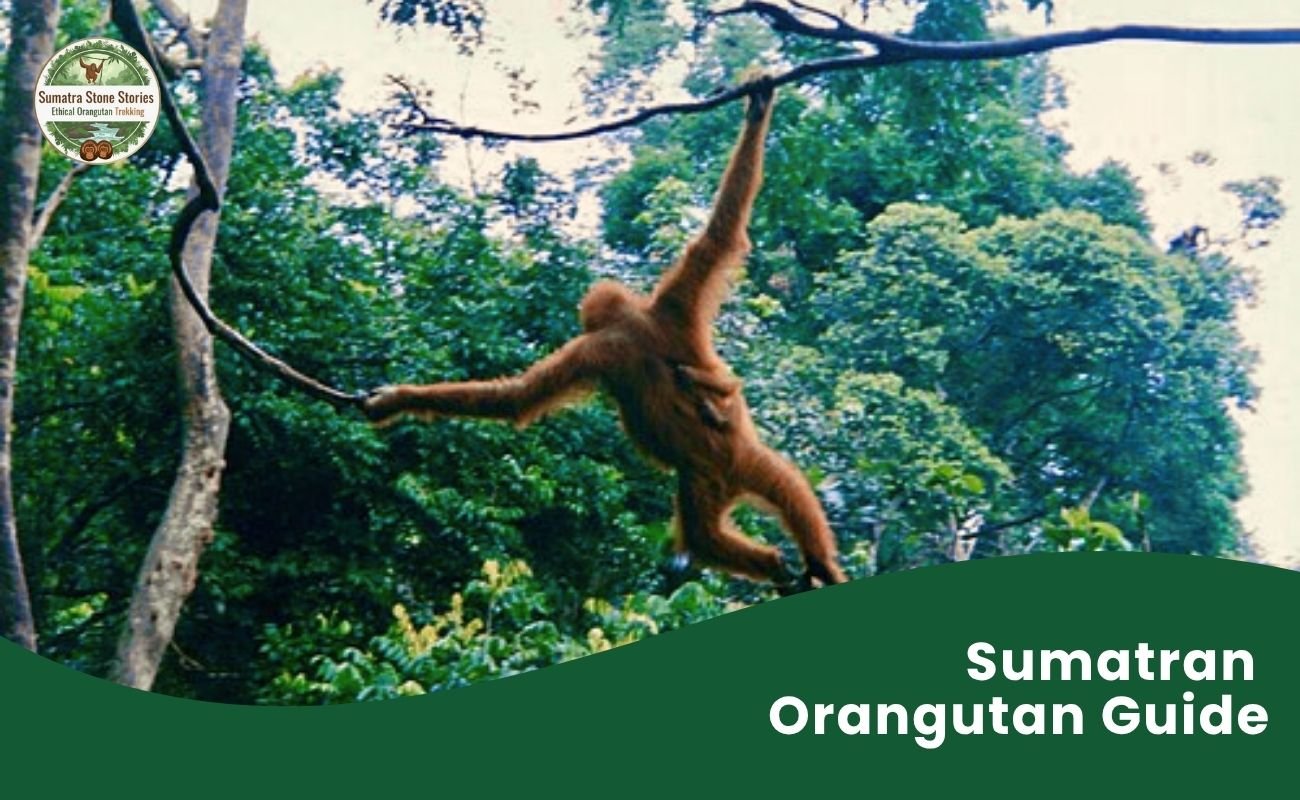
The Sumatran orangutan is one of the rarest great apes on Earth, and one of the most remarkable. Found only in the rainforests of northern Sumatra, this red-haired primate spends almost its entire life in the treetops, rarely touching the ground. It is also a species running out of time. Recent surveys show its population has fallen sharply in just over a decade, making every remaining animal and every hectare of forest it depends on more important than ever.
This guide covers what the Sumatran orangutan is, where it lives, how it behaves, why its numbers keep dropping, and how travelers can responsibly see one in the wild.
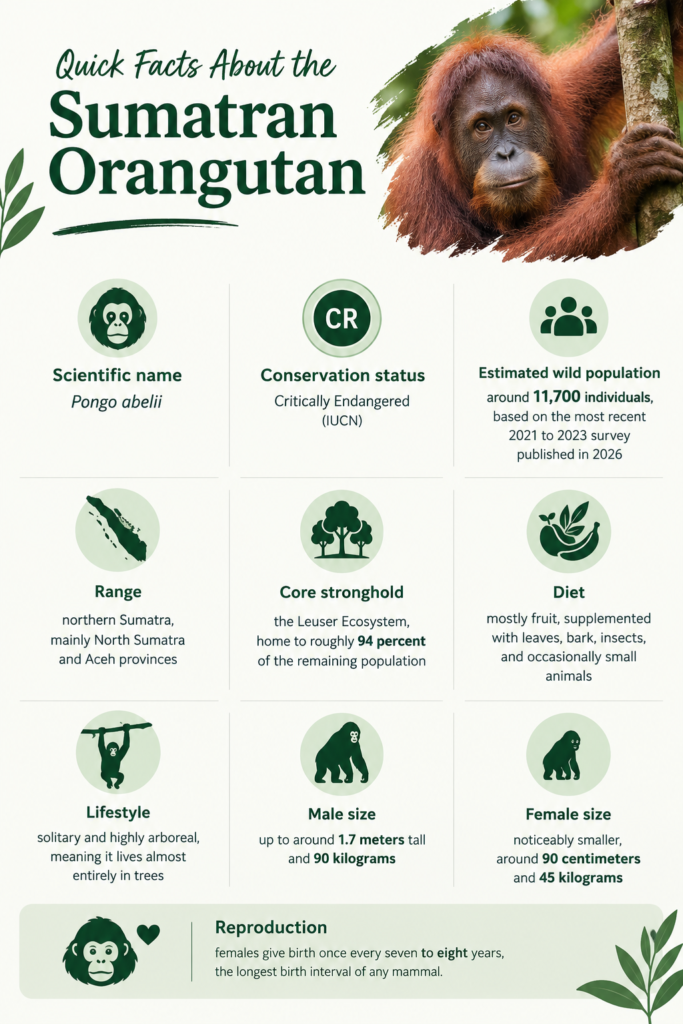
Quick Facts About the Sumatran Orangutan
- Scientific name: Pongo abelii
- Conservation status: Critically Endangered (IUCN)
- Estimated wild population: around 11,700 individuals, based on the most recent 2021 to 2023 survey published in 2026
- Range: northern Sumatra, mainly North Sumatra and Aceh provinces
- Core stronghold: the Leuser Ecosystem, home to roughly 94 percent of the remaining population
- Diet: mostly fruit, supplemented with leaves, bark, insects, and occasionally small animals
- Lifestyle: solitary and highly arboreal, meaning it lives almost entirely in trees
- Male size: up to around 1.7 meters tall and 90 kilograms
- Female size: noticeably smaller, around 90 centimeters and 45 kilograms
- Reproduction: females give birth once every seven to eight years, the longest birth interval of any mammal
Is the Sumatran Orangutan a Real Species, or Just an Orangutan From Sumatra?
There are actually three recognized orangutan species, and it is easy to confuse them.
Bornean orangutan (Pongo pygmaeus) lives on the island of Borneo and is the most numerous of the three, with a population estimated at around 100,000.
Sumatran orangutan (Pongo abelii) lives only on Sumatra, mainly in the north of the island.
Tapanuli orangutan (Pongo tapanuliensis) was only formally described as a separate species in 2017. It survives in a single, isolated area around Batang Toru, south of the Sumatran orangutan’s range, with fewer than 720 individuals left. It is the rarest great ape in the world.
So yes, orangutans in Sumatra are genuinely a distinct species from their Bornean relatives, separated by roughly one to two million years of evolution. Compared to Bornean orangutans, Sumatran orangutans tend to have lighter, more reddish fur, longer facial hair, and a more strictly tree-dwelling lifestyle. They rarely come down to the forest floor at all, partly because Sumatra still has Sumatran tigers, a ground predator that Borneo does not.
What Does a Sumatran Orangutan Look Like?
Sumatran orangutans have shaggy, reddish-orange fur, long arms that can stretch wider than the animal’s own height, and short, bowed legs built for climbing rather than walking.
The Male Sumatran Orangutan
Adult males are dramatically larger than females and go through a striking physical transformation as they mature. Dominant males develop wide cheek pads, called flanges, along with a prominent throat pouch used to amplify their calls, and a beard and moustache of longer facial hair. A male in this flanged stage can weigh close to 90 kilograms, roughly twice the weight of an adult female.
Interestingly, not every male develops flanges on the same timeline. Some males stay smaller and unflanged for years, sometimes over a decade, and only develop these features once a dominant flanged male in the area dies or moves on. This flexible development is unusual among primates and still fascinates researchers studying orangutan biology.
The Female Sumatran Orangutan
Females are smaller, generally under a meter tall and around 45 kilograms, without the cheek flanges males develop. Females are the primary caregivers, and a young orangutan will stay close to its mother for six to eight years, longer than almost any other mammal, learning which fruits are safe to eat, how to build a nest, and how to move safely through the canopy.
Habitat of the Sumatran Orangutan
Sumatran orangutans live in lowland and montane tropical rainforest, along with some peat swamp forest, all concentrated in the northern tip of Sumatra. Their historical range once covered much of the island and even stretched into Java, but deforestation over the last century has pushed the species into a fraction of its former territory.
Today, the vast majority of wild Sumatran orangutans live within the Leuser Ecosystem, a roughly 2.6 million hectare block of forest spanning Aceh and North Sumatra provinces. This ecosystem includes Gunung Leuser National Park, the single most important stronghold for the species and the best known place to encounter wild orangutans.
Within Gunung Leuser, the village of Bukit Lawang sits right on the edge of the forest and has become the main gateway for observing orangutans in a natural setting, rather than in captivity or a rehabilitation center. Because the terrain here ranges from gentle riverside trails to steep, remote jungle, trek difficulty and the chances of an encounter vary considerably depending on how far into the park you go.
A smaller number of Sumatran orangutans also survive in fragmented forest patches outside formally protected areas, which makes them more vulnerable to conflict with people and further habitat loss.
Sumatran Orangutan Behavior and Diet
Orangutans are the most solitary of the great apes, and Sumatran orangutans follow this pattern closely. Adult males generally live alone, ranging across large stretches of forest without defending a fixed territory the way many other primates do. Adult females are more likely to associate with other females and their offspring, but even they spend most of their time apart from other adults.
Their diet is dominated by fruit, particularly the fig and durian family trees found throughout Gunung Leuser. When fruit is scarce, they fall back on bark, leaves, flowers, and honey, and Sumatran orangutans are notably more insectivorous than their Bornean relatives, regularly eating termites, ants, and other insects for protein.
Every night, an orangutan builds a fresh nest high in the canopy from bent branches and leaves, a skill young orangutans learn from their mothers by around one year old. This nest building behavior is one of several examples of tool use and learned skill that make orangutans among the most cognitively advanced animals in the world, alongside their documented use of sticks to extract insects or seeds and leaves as makeshift umbrellas during rain.
Adult males also produce a distinctive “long call”, a loud vocalization that can travel over a kilometer through dense forest, used to signal their location to females and warn off rival males without direct confrontation.
Sumatran Orangutan Population and Conservation Status
The Sumatran orangutan has been listed as Critically Endangered on the IUCN Red List since 2000, and the trend line has continued in the wrong direction.
Older estimates put the population at roughly 7,300 individuals in 2004, rising to estimates between 13,800 and 14,600 following more comprehensive surveys over the following decade as monitoring methods improved. The most recent and most rigorous assessment, based on fieldwork carried out between 2021 and 2023 by Indonesia’s Ministry of Forestry alongside Indonesian and international researchers, estimated the population at approximately 11,694 individuals, a decline of around 19.5 percent compared to a matched 2011 baseline, or roughly 1.8 percent per year.
That same 2026 study found something conservationists consider especially concerning: habitat loss alone does not explain the decline. Killing, human-wildlife conflict, and forest fragmentation are all contributing, even in areas where the forest itself has not shrunk dramatically. Around 18 percent of the combined Sumatran and Tapanuli orangutan population now lives outside formally protected areas, where these risks are highest.
Why Are Sumatran Orangutans Endangered?
A few overlapping pressures explain the decline.
Deforestation and habitat fragmentation. Palm oil expansion, illegal logging, and road building have all cut into the lowland forest orangutans depend on, splitting one continuous habitat into isolated patches that are harder for orangutans to move between.
Human-wildlife conflict. As forest edges shrink and orangutans forage closer to farms and villages, conflict with people increases, sometimes resulting in orangutans being killed or captured.
Illegal wildlife trade. Infant orangutans are occasionally captured for the illegal pet trade, usually after the mother is killed, since females rarely give up their young voluntarily.
Slow reproduction. With females giving birth only once every seven to eight years, Sumatran orangutan populations recover from losses far more slowly than most other mammals, so even a modest increase in deaths can drive a lasting decline.
List of Conservation Efforts Protecting the Sumatran Orangutan
Several organizations work directly on Sumatran orangutan conservation, most notably the Sumatran Orangutan Conservation Programme (SOCP), which runs rescue, rehabilitation, and reintroduction work across North Sumatra and Aceh, including a successful reintroduction population established in Bukit Tiga Puluh National Park in Jambi and Riau.
Protecting the Leuser Ecosystem itself is widely considered the single most important conservation priority, since it holds the large majority of the remaining wild population. This includes anti-poaching patrols, habitat corridor restoration to reconnect fragmented forests, and ongoing population monitoring like the 2026 survey that produced the current population estimate.
Responsible tourism also plays a supporting role. Trekking permits and guide fees in areas like Bukit Lawang help fund park management and give local communities an economic incentive to protect the forest rather than clear it. This is the space we work in at Sumatra Stone Stories, organizing small, low-impact jungle treks into Gunung Leuser that follow strict wildlife viewing guidelines designed to keep both visitors and orangutans safe.
Are There Orangutans in Sumatra You Can Actually See?
Yes. Unlike many endangered species that are difficult or impossible to observe in the wild, Sumatran orangutans can genuinely be seen on a 2-day guided trek into Gunung Leuser National Park, most commonly from Bukit Lawang.
Sightings are never guaranteed, since these are wild, free-ranging animals rather than a managed exhibit, but the area around Bukit Lawang has a strong track record of encounters, particularly with younger, semi-habituated individuals closer to the park boundary. Fully mature males tend to stay deeper in the forest and are harder to find, which is part of why longer treks generally offer a different, more remote kind of experience than a short day trip.
Any responsible trek should keep a safe distance from orangutans, avoid feeding them, and follow a local guide’s instructions closely, both to protect visitors and to prevent the animals from becoming dependent on human food or losing their natural wariness of people.
Frequently Asked Questions
What is the difference between a Sumatran and Bornean orangutan?
They are separate species. Sumatran orangutans are generally lighter in color, have longer facial hair, and spend almost all their time in trees, while Bornean orangutans are somewhat darker, bulkier, and more willing to travel on the ground.
How many Sumatran orangutans are left in the wild?
The most recent comprehensive survey, covering 2021 to 2023, estimated around 11,694 individuals, a decline of roughly 19.5 percent since 2011.
Where do Sumatran orangutans live?
Almost entirely within the Leuser Ecosystem in northern Sumatra, spanning Aceh and North Sumatra provinces, with Gunung Leuser National Park as the main stronghold.
Why are Sumatran orangutans important?
As major seed dispersers, they help maintain forest diversity and regeneration across the ecosystems they inhabit, which in turn supports countless other species that share their habitat.
Can you see wild orangutans in Sumatra without a guide?
It is not recommended and, in most protected areas, not permitted. Licensed local guides know current orangutan locations, understand safe viewing distances, and are trained to respond appropriately if an animal approaches, which keeps both visitors and orangutans safer.
How long do Sumatran orangutans live?
In the wild, they can live 35 to 45 years, with some individuals in protected care living into their 50s.