Sumatra holds one of the last places on Earth where wild orangutans still swing freely through ancient rainforest canopy. The Sumatran orangutan, known scientifically as Pongo abelii, shares this home with tigers, elephants, rhinos, and hundreds of other species inside a single connected forest system. Understanding this ecosystem means understanding why every tree, river and hillside in this region matters.
What Makes Up the Sumatran Orangutan Ecosystem
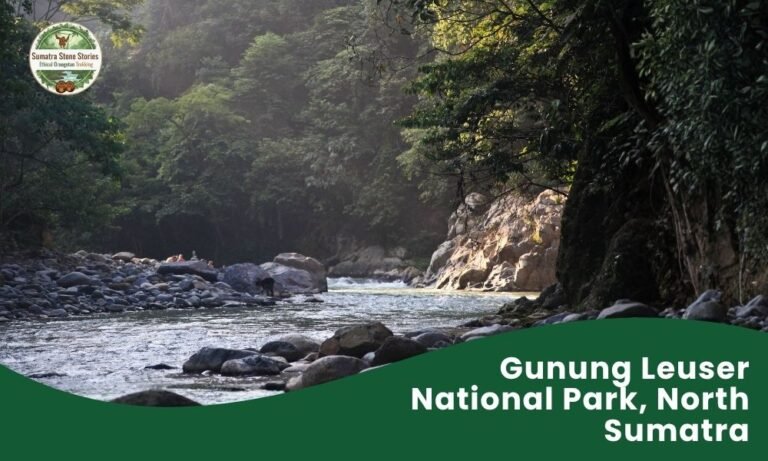
The Sumatran orangutan lives almost entirely within the Leuser Ecosystem, a vast stretch of rainforest spanning more than 2.6 million hectares across Aceh and North Sumatra. At its heart sits Gunung Leuser National Park, covering close to 800,000 hectares of lowland forest, river valleys and mountain slopes that climb past 3,000 meters at the summit of Mount Leuser itself.
This park forms part of the Tropical Rainforest Heritage of Sumatra, a UNESCO World Heritage Site recognized for its extraordinary biodiversity. Scientists estimate the wider ecosystem holds around 380 bird species, close to 200 reptiles and amphibians, and roughly 130 mammal species. It remains the only place on the planet where orangutans, tigers, elephants, and rhinos still live together in the same forest.
Bukit Lawang sits right at the edge of this park and works as the main entry point for anyone wanting to see this ecosystem up close. From here, trails lead straight into the forest where orangutans move naturally through the trees without any human feeding or interference.
Why Orangutans Matter to This Forest
Orangutans do far more than draw visitors to the jungle. They act as a keystone species, meaning the health of the entire forest depends partly on them. As they travel through the canopy searching for fruit, they swallow seeds and drop them across wide areas of forest. This natural seed dispersal helps new trees grow in places they otherwise never would.
Because orangutans need large stretches of connected forest to survive, protecting their habitat automatically protects thousands of other plants and animals sharing the same space. Conservationists often call this an umbrella effect. Save the orangutan’s home, and everything living underneath that umbrella benefits too.
The Threats Facing This Ecosystem
Despite its protected status, the Leuser Ecosystem faces constant pressure. Illegal logging continues to strip forest cover in areas that are supposed to be off limits. Land clearing for palm oil plantations has pushed deep into orangutan habitat over the past few decades, cutting the forest into smaller, disconnected patches.
When forest gets fragmented like this, orangutans lose the ability to move freely between feeding grounds. Smaller populations become isolated from each other, which weakens genetic diversity over time. Poaching and the illegal wildlife trade add further strain, particularly on infant orangutans separated from their mothers.
Fewer than 14,000 Sumatran orangutans are believed to remain in the wild today, making them one of the most critically endangered great apes on the planet. Most of the surviving population lives within Gunung Leuser National Park and the surrounding Leuser Ecosystem, which makes this specific patch of forest genuinely irreplaceable.
Conservation Efforts Protecting the Forest
Organizations working across North Sumatra and Aceh run active programs to rescue, rehabilitate and reintroduce orangutans displaced by habitat loss. Rangers patrol sections of the park to stop illegal logging and hunting. Local communities have also become part of the solution, with many former loggers now working as trekking guides instead.
This shift matters because it gives people a reason to protect the forest rather than clear it. When a standing forest full of wild orangutans becomes more valuable than a cleared plot of farmland, conservation starts to work with local economies instead of against them.
How Responsible Trekking Supports the Ecosystem
Visiting Gunung Leuser National Park the right way plays a real part in keeping this ecosystem alive. Ethical trekking means keeping a respectful distance from wild orangutans, never feeding them and following guides trained to read the forest without disturbing it.
At Sumatra Stone Stories, our treks through Bukit Lawang and into Gunung Leuser National Park follow exactly this approach. Guides know the difference between observing wildlife and interfering with it, and the 2-day orangutan trekking is built around letting the forest stay wild. Income from trekking also supports local families who now depend on tourism rather than logging, which keeps more forest standing for the orangutans that need it.
A Forest Worth Experiencing Carefully
The Sumatran orangutan ecosystem is not just a backdrop for a jungle trek. It is one of the most biologically rich and genuinely threatened environments left on Earth. Walking through it with a guide who respects that fact turns a simple trek into something that actually supports the forest’s future, rather than adding pressure to it.